Where Is Work Waiting? Four Flow Metrics That Make It Visible
WIP, cycle time, throughput and work item age: the four flow metrics that show where work waits, what they tell you and how to use them.
Articles / Agile Ways of Working
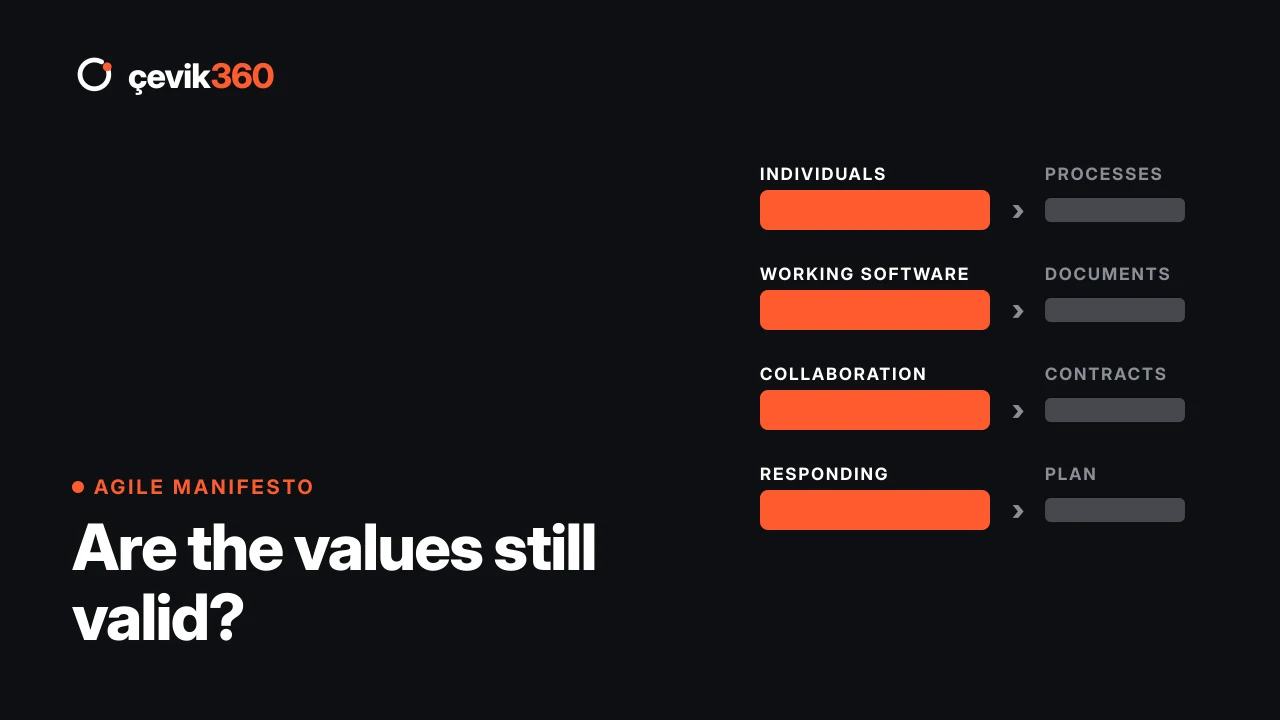
The Manifesto for Agile Software Development was written in February 2001, when seventeen software developers came together. It’s a short text: four values and twelve principles. More than twenty years later, teams use agile methods not only for software but for marketing, operations and HR, and AI is changing how work gets done all over again. So, are the manifesto’s values still valid?
The manifesto comes down to four preferences:
The most overlooked sentence of the text comes right after: while there is value in the items on the right, we value the items on the left more. In other words, the manifesto doesn’t reject processes, documents, contracts or plans; it says what comes first when you have to choose.
Tools have never been more powerful. Still, no tool on its own solves a misunderstanding between two teams. A large share of the delays we see in the field come not from technology but from communication and hand-offs. This value is at least as valid today as it was in 2001.
For teams outside software, this value should be read as “working output”: a concrete result the customer can use and give feedback on. Talking about progress through the output itself, rather than through reports, is still the most reliable measure of progress.
Contracts are necessary, but a good product doesn’t come from contract clauses; it comes from a frequent, honest feedback loop with the customer. In organisations working with several suppliers, this value extends to supplier relationships too.
Planning matters; the manifesto questions not planning but blind adherence to the plan. Working in short cycles and getting frequent feedback turns change from a threat into an opportunity.
The manifesto’s principles describe how the values show up in daily work. Those that stand out most for us today:
The last principle is the foundation of continuous improvement and retrospectives.
AI tools are speeding up much of the work, from writing code to analysis. That doesn’t make the manifesto’s values outdated; it makes them more important:
The manifesto’s four values still hold today. What changes is the context they’re applied in: teams beyond software, scaling organisations and ways of working reshaped by AI. What matters is using the manifesto not as a rule book but as a compass for decisions.
To manage AI use in your teams in line with agile principles, have a look at our AI and agile governance services. Related: What is Scrum?
WIP, cycle time, throughput and work item age: the four flow metrics that show where work waits, what they tell you and how to use them.
AI speeds up coding, but work still waits for decisions, reviews and tests. What to know before you shorten your sprints.
The eight most common mistakes in agile adoption, from ignoring culture to limiting team autonomy, and how to avoid them.
In a 30-minute call, let's find the bottlenecks in your flow together.