Where Is Work Waiting? Four Flow Metrics That Make It Visible
WIP, cycle time, throughput and work item age: the four flow metrics that show where work waits, what they tell you and how to use them.
Articles / Lean & Continuous Improvement
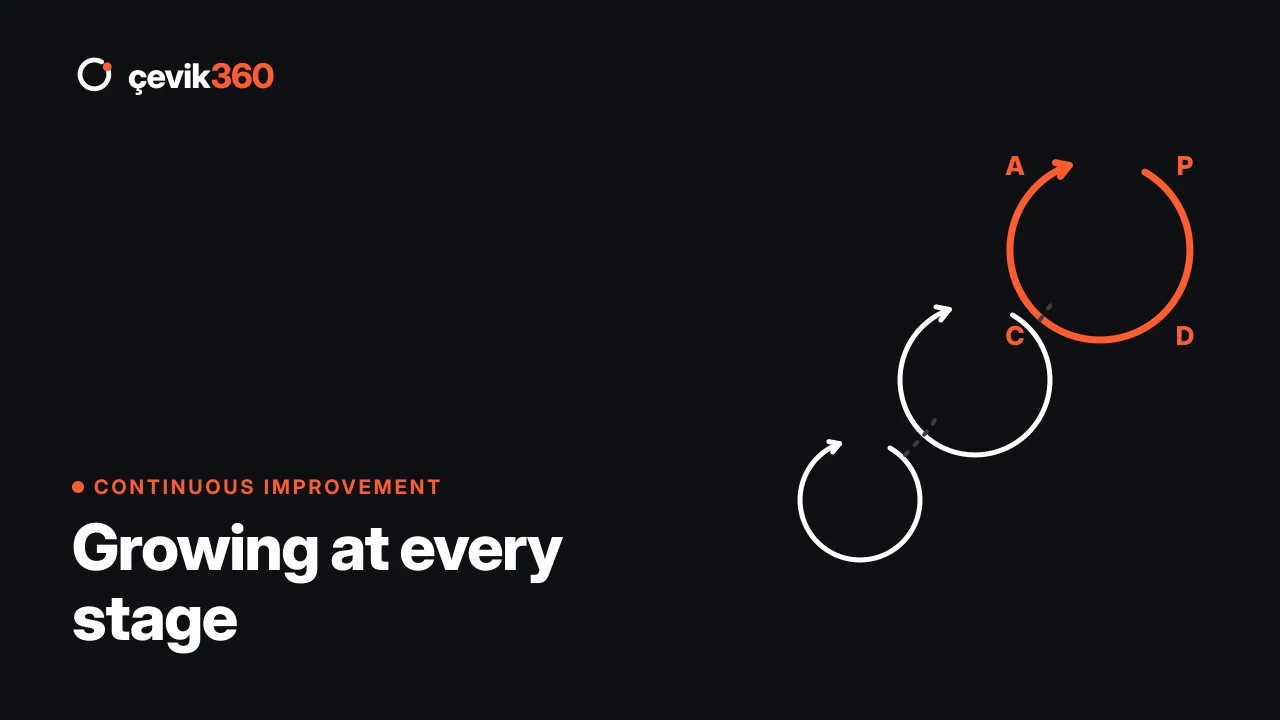
Continuous improvement is the discipline of making the way you work better through small, regular steps. Its roots lie in lean thinking and the Japanese concept of Kaizen, “change for the better”. In agile methods, it becomes part of daily work through retrospectives, short cycles and feedback.
What brings lasting results in agile and lean transformations isn’t the big changes of the first months, but the small improvements made every week afterwards. In this article we look at how continuous improvement works and how to make it last in your organisation.
The best-known model of continuous improvement is the PDCA (Plan – Do – Check – Act) cycle:
The Sprint cycle and retrospective in Scrum are essentially a team-level application of this cycle.
Instead of big transformation programmes, run small, reversible experiments that show results quickly. Small steps reduce risk and speed up learning.
Improvement starts with seeing the current situation. If you can’t see where work waits, which steps add value and where work is redone, improvement rests on opinions. You can’t manage what you can’t see.
Flow metrics (cycle time, throughput, work in progress and the age of waiting work) are the compass of improvement. Only with this data can you tell whether a change worked. To start your retrospectives with data, see our Sprint Retrospective tips.
Treating symptoms makes the same problem reappear somewhere else. Use techniques such as the “5 Whys” and fishbone diagrams to get beneath problems.
If all of a team’s capacity goes to delivery, improvement always stays something to do “later”. Put improvement work in the backlog and deliberately make time for it.
Continuous improvement isn’t the job of an expert team but of everyone who does the work. The best improvement ideas come from the people who live with the problem every day. Leaders’ role is to remove the obstacles in front of those ideas.
Improvement isn’t only about solving problems. Spreading a practice that works in one team to others is one of the fastest ways to improve.
Continuous improvement works at different levels, with different rhythms:
When these levels aren’t connected, teams improve internally but the organisation’s end-to-end performance doesn’t change.
Agile and lean methods give organisations a strong foundation for continuous improvement. But what makes that foundation work is visibility, data, capacity and leadership support. When improvement is part of daily work, the organisation keeps growing at every stage.
Related: Moving to Kanban, Five stages of becoming an agile learning organisation. To build a lasting improvement system, have a look at our continuous improvement services.
WIP, cycle time, throughput and work item age: the four flow metrics that show where work waits, what they tell you and how to use them.
AI speeds up coding, but work still waits for decisions, reviews and tests. What to know before you shorten your sprints.
The eight most common mistakes in agile adoption, from ignoring culture to limiting team autonomy, and how to avoid them.
In a 30-minute call, let's find the bottlenecks in your flow together.