Where Is Work Waiting? Four Flow Metrics That Make It Visible
WIP, cycle time, throughput and work item age: the four flow metrics that show where work waits, what they tell you and how to use them.
Articles / Agile Ways of Working
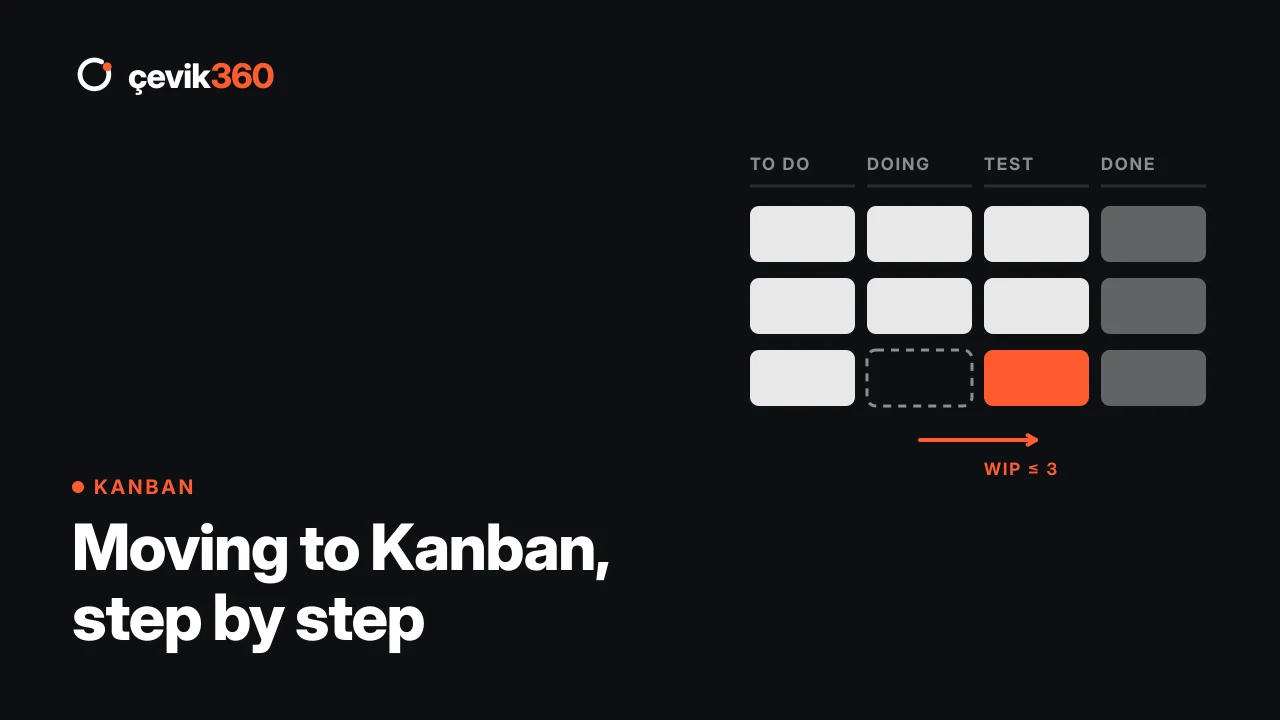
Kanban is a method that makes visible how work flows and improves that flow step by step. Unlike Scrum, it doesn’t introduce new roles or fixed-length cycles; it starts from your current way of working and evolves it. That’s why moving to Kanban isn’t an “installation” but an improvement journey.
An observation from the field: Scrum works very well when all the resources are at your own desk. When work changes hands between several suppliers and teams, Kanban’s focus on flow usually delivers results faster. To compare the two, see What is Scrum?
Before moving to Kanban, learn how work flows today:
The answers determine your board’s columns and your improvement priorities.
The point of a board isn’t to look nice; it’s to show reality. Columns should reflect the team’s real working steps. For a good start:
You can’t manage what you can’t see. Every piece of work that doesn’t make it onto the board is a hidden consumer of capacity.
The heart of Kanban is limiting how many items are worked on at the same time. WIP limits push the team towards “finishing what we started” instead of “starting something new”. When setting limits:
When does an item move to the next column? What do “ready” and “done” mean? How is urgent work handled? Having these rules written down where everyone can see them moves discussions from people to rules.
In Kanban you talk about progress with data, not feelings. Four metrics are enough to start:
These metrics let you answer “when will it be done?” with probabilities instead of guesses.
Kanban doesn’t impose fixed events, but without regular conversations there’s no improvement. Common loops:
Instead of moving the whole organisation to Kanban at once, start with a pilot team. Show the pilot’s results with metrics; a success story is the strongest way to convince the next teams. If several teams depend on each other, consider a portfolio board on top of the team boards that shows end-to-end flow.
Does Kanban have a Scrum Master or Product Owner? Kanban doesn’t define new roles. In practice, many teams define a service delivery manager who manages flow and a service request manager who prioritises requests.
Can Scrum and Kanban be used together? Yes. Many Scrum Teams manage the work inside their Sprint with a Kanban board, WIP limits and flow metrics.
How long does moving to Kanban take? The first board can be set up in a few days. The real gains come from small improvements made over a few months by looking at the data.
Curious how we brought a scattered team at an airline into a single Kanban structure? Have a look at our cases. To review your own flow together, you can request a free assessment.
WIP, cycle time, throughput and work item age: the four flow metrics that show where work waits, what they tell you and how to use them.
AI speeds up coding, but work still waits for decisions, reviews and tests. What to know before you shorten your sprints.
The eight most common mistakes in agile adoption, from ignoring culture to limiting team autonomy, and how to avoid them.
In a 30-minute call, let's find the bottlenecks in your flow together.