Where Is Work Waiting? Four Flow Metrics That Make It Visible
WIP, cycle time, throughput and work item age: the four flow metrics that show where work waits, what they tell you and how to use them.
Articles / Agile Ways of Working
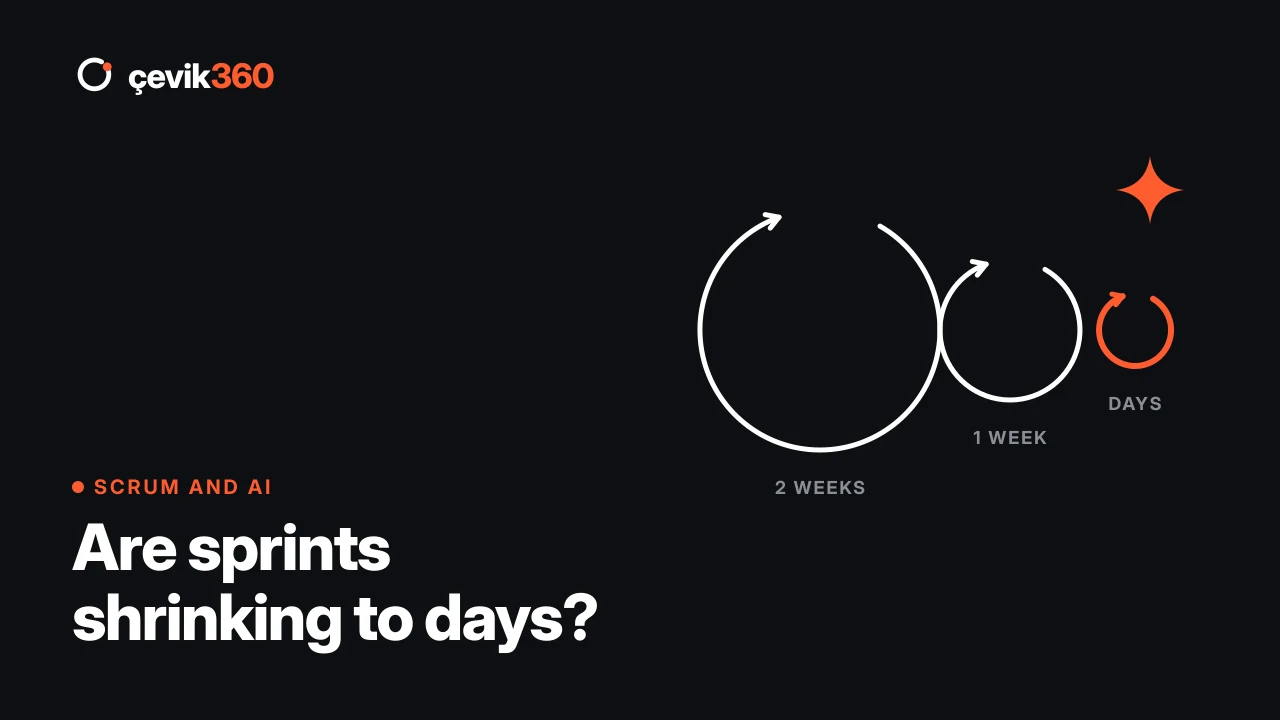
Over the last two years, AI assistants have moved into the daily work of teams. Writing code, drafting test cases, producing documentation and finding the source of a bug all take far less time than they used to. That speed raises an obvious question: if work can be produced this fast, do two-week sprints still make sense? Should sprints shrink from weeks to days?
The short answer: sprints can get shorter, and for some teams they should. But before you change anything, you need to see clearly what AI speeds up and what it doesn’t. Otherwise you will just hit the same bottleneck more often.
Google’s DORA research programme has been looking at this question with data for two years. The 2024 DORA report found that a 25% increase in AI adoption was associated with about a 7.5% improvement in documentation quality, 3.4% in code quality and 3.1% in code review speed. The same report also observed that as AI adoption increased, delivery throughput fell by an estimated 1.5% and delivery stability by 7.2%.
The 2025 DORA report changed the picture somewhat: 90% of respondents now use AI at work, and this year AI adoption showed a positive relationship with delivery throughput. The relationship with stability, however, is still negative. The report’s main message fits in one sentence: AI doesn’t fix a team; it amplifies what’s already there. Teams with strong test automation, small batches and fast feedback win. Teams with tightly coupled systems and slow approvals push more change through the same narrow bottleneck.
What we see in the field points the same way. Most of the time between “started” and “done” is not spent writing code but waiting: for a prioritisation decision, for business sign-off, for code review, for a test environment, for another team’s dependency. AI shortens the writing; it doesn’t touch the waiting. And because more work gets produced, review and test queues can even grow longer.
The Scrum Guide defines sprints as fixed-length events of one month or less. So one-week sprints, or even shorter ones, are perfectly legitimate Scrum. The real question behind sprint length is: how often do we need to learn and be able to change direction?
A sprint is less a box for producing work and more a feedback loop. The sprint goal, the review and the retrospective make the team ask regularly: are we building the right thing, and are we building it right? As AI speeds up the work, it makes sense for that loop to run more often. But shortening the loop means speeding up every step inside it too.
What stays: the sprint goal, transparency, the review and the retrospective. They matter even more in the age of AI, because when a team produces more output it is easier to miss the question “is this output turning into an outcome?”
What changes:
For some teams the right answer is not a one-week sprint but leaving fixed timeboxes behind and moving to continuous flow. If work arrives in different sizes at unpredictable times, if the team depends on several suppliers, or if priorities are discussed with the business every day, Kanban may be a more natural fit. Instead of sprints, Kanban uses WIP limits, service level expectations and regular feedback loops.
In practice many teams combine the two: they keep the Scrum rhythm for the sprint goal and review, and manage flow inside the sprint with Kanban metrics.
AI doesn’t make the Scrum Master’s job smaller; it shifts its focus. As note-taking and reporting get automated, the real value moves to questions like these:
That last question is the most important one of the AI era. The bottleneck is no longer “can we build it?” but “what should we build, and did it work?”
If you are thinking about taking your sprints from weeks to days, we suggest this order:
If you’d like to see together where your teams’ work waits, you can start with our free 360 assessment. Our approach to agile transformation is on the services page.
WIP, cycle time, throughput and work item age: the four flow metrics that show where work waits, what they tell you and how to use them.
The eight most common mistakes in agile adoption, from ignoring culture to limiting team autonomy, and how to avoid them.
What is Scrum@Scale and how does it work? Scrum of Scrums, MetaScrum, the Executive Action Team and the two cycles; how it differs from SAFe and LeSS.
In a 30-minute call, let's find the bottlenecks in your flow together.