Where Is Work Waiting? Four Flow Metrics That Make It Visible
WIP, cycle time, throughput and work item age: the four flow metrics that show where work waits, what they tell you and how to use them.
Articles / Agile Ways of Working
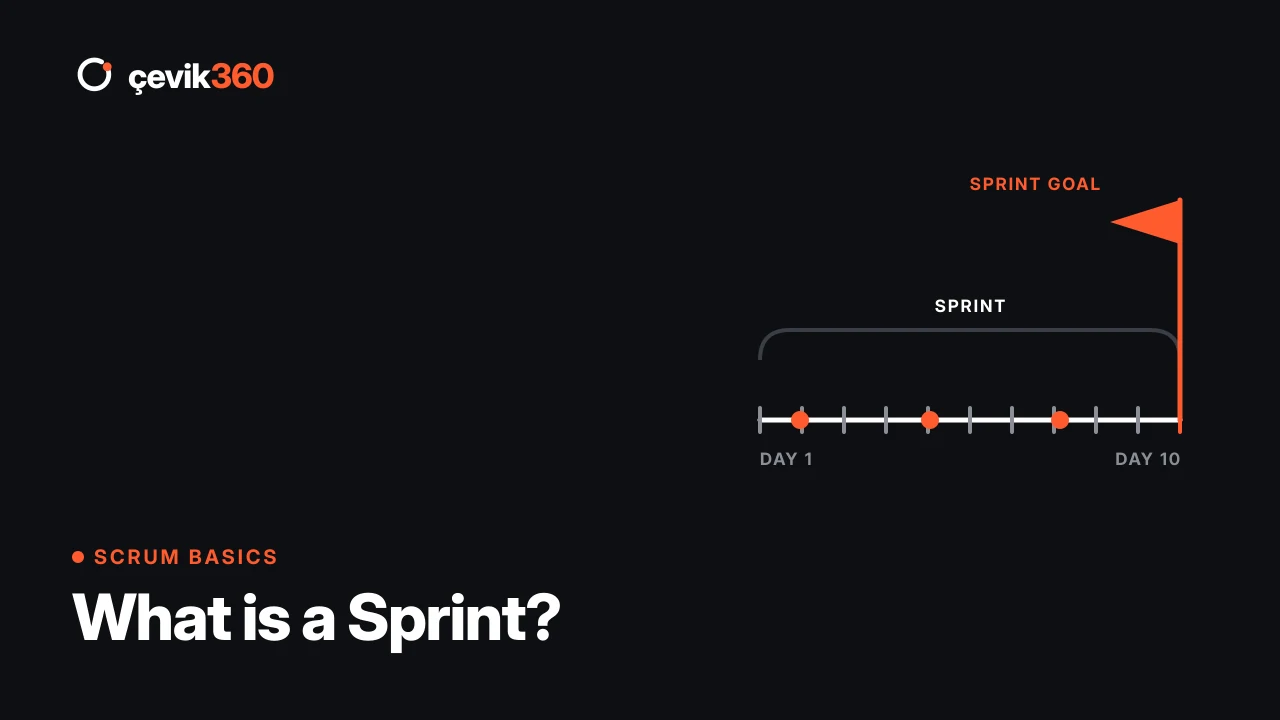
In Scrum, a Sprint is a fixed-length period of one month or less in which the team produces a usable piece of the product. It’s the heart of Scrum: planning, the daily meetings, the review and the retrospective all happen inside a Sprint. As soon as one Sprint ends, the next begins.
For the big picture of Scrum, start with What is Scrum?
Teams working with long plans usually find out how far off course they are only when the work is finished. A Sprint reduces that risk: every few weeks you produce something that works, get real feedback and correct course. That way you never risk more than one Sprint’s worth of effort.
According to the Scrum Guide, a Sprint lasts one month at most. Most teams choose two weeks. These questions help you pick the right length:
Whatever length you choose, keep it fixed. Rhythm matters for the predictability of the team and its stakeholders.
Every Sprint starts with three questions the team answers together:
For a one-month Sprint, planning takes at most eight hours; for shorter Sprints it is usually proportionally shorter.
A Sprint Goal isn’t a list of unrelated tasks; it’s a one-sentence purpose. A good Sprint Goal:
A note from the field: if your team keeps missing Sprints because of external dependencies, the problem isn’t the Sprint length but where the work waits. Measuring flow and making waiting visible helps more than shortening the Sprint.
Is a Sprint the same as an iteration? They’re similar ideas. Sprint is Scrum’s name for an iteration, defined by rules such as a fixed length, a Sprint Goal and a usable increment.
Is there a gap between Sprints? No. A new Sprint starts the moment the previous one ends; the review and the retrospective are part of the Sprint.
What happens to unfinished work? It goes back to the Product Backlog and is re-prioritised. Whether it’s selected again is decided in the next Sprint Planning.
Why do your Sprints overflow, and where does the work wait? Let’s look together with our free 360 assessment.
WIP, cycle time, throughput and work item age: the four flow metrics that show where work waits, what they tell you and how to use them.
AI speeds up coding, but work still waits for decisions, reviews and tests. What to know before you shorten your sprints.
The eight most common mistakes in agile adoption, from ignoring culture to limiting team autonomy, and how to avoid them.
In a 30-minute call, let's find the bottlenecks in your flow together.