Leadership in Scrum: The Key Factor Behind Failures
Why does Scrum get stuck because of leadership? Servant leadership, what missing leadership does to teams, and six areas leaders should develop.
Articles / Agile Leadership
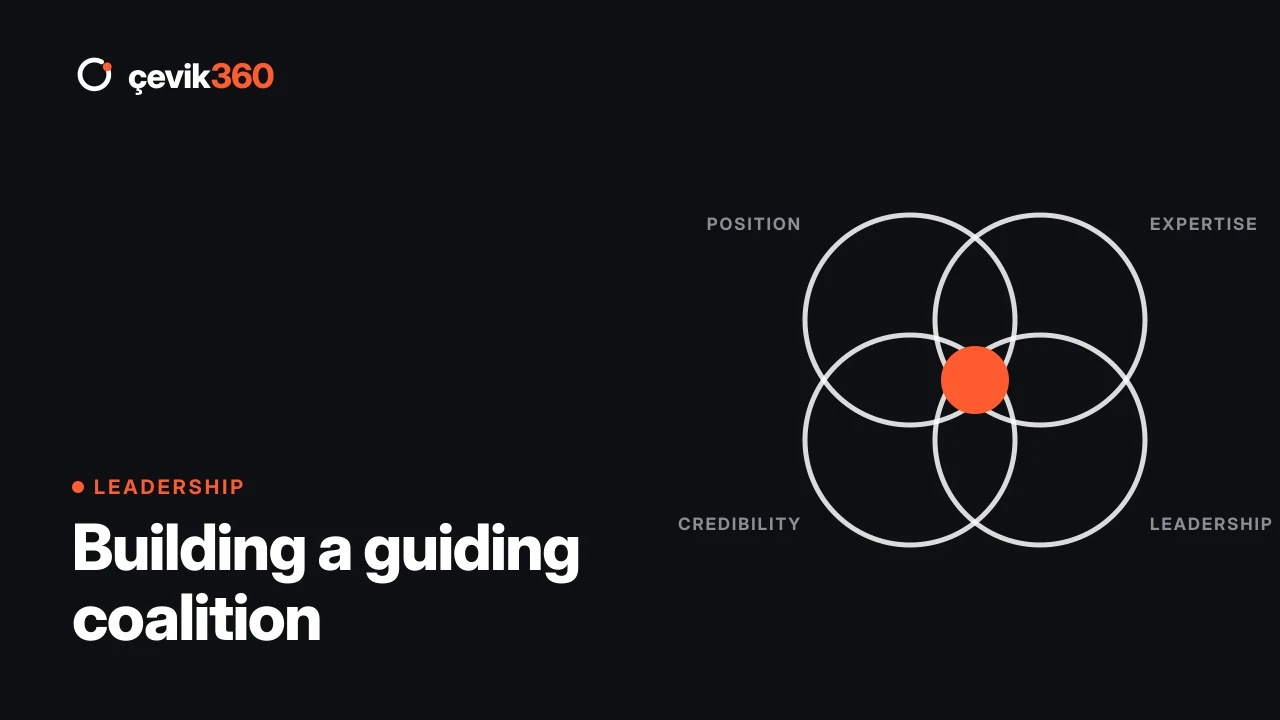
Agile transformations often start on the shoulders of a single team or a few enthusiastic people. In the first months excitement is high, but once the transformation starts touching the organisation’s structure, budget and priorities, this small group isn’t enough. That’s when you need a strong coalition to guide the change.
In John Kotter’s change management model, building a “guiding coalition” is one of the first steps of a successful transformation. In agile transformations, this coalition brings together managers, team representatives and the people who will really carry the change.
For the sponsor’s role, see The CEO and sponsor factor in agile transformation.
A good coalition combines four qualities:
A coalition chosen only by job title looks strong on paper but has little effect on the ground. Don’t forget to include people who are influential in the organisation’s informal networks.
Why is the transformation needed now, and why for this organisation? Instead of a general goal like “being faster”, start from a measurable problem: delivery times, customer complaints, waiting requests.
The coalition should track the transformation’s progress with data. Flow metrics (delivery time, throughput, waiting work) and business results move meetings from opinions to facts.
The coalition itself should work in an agile way: like a team with its own backlog, regular meetings and its own retrospectives. That way it shows agile working by example instead of just talking about it.
Structural obstacles raised by teams should go into the coalition’s backlog. If the coalition can’t remove them, it’s either made up of the wrong people or lacks the authority.
Concrete results from pilot teams are the strongest way to convince sceptics. Share successes with numbers.
As the transformation spreads, add representatives from new units. Over time, the coalition should give way to a permanent governance structure that sustains the transformation.
Would you like to design the structure that will guide your transformation together? Have a look at our agile transformation services or request a free assessment.
Why does Scrum get stuck because of leadership? Servant leadership, what missing leadership does to teams, and six areas leaders should develop.
What is the CEO's or sponsor's role in an agile transformation? Vision, removing obstacles, communication and leading by example.
What is customer-centric agility? How to put the customer at the centre of work with feedback loops, end-to-end flow, the right measures and leadership.
In a 30-minute call, let's find the bottlenecks in your flow together.