Where Is Work Waiting? Four Flow Metrics That Make It Visible
WIP, cycle time, throughput and work item age: the four flow metrics that show where work waits, what they tell you and how to use them.
Articles / Agile Ways of Working
Most transformation programmes start with the same sentence: “We’re moving to a new model.” New roles are defined, new teams are formed, new meetings land in the calendar. A few months later, part of the organisation has adopted the new model and part of it has quietly slipped back into old habits. Usually the reason isn’t that the model was wrong; it’s that the change landed on people all at once.
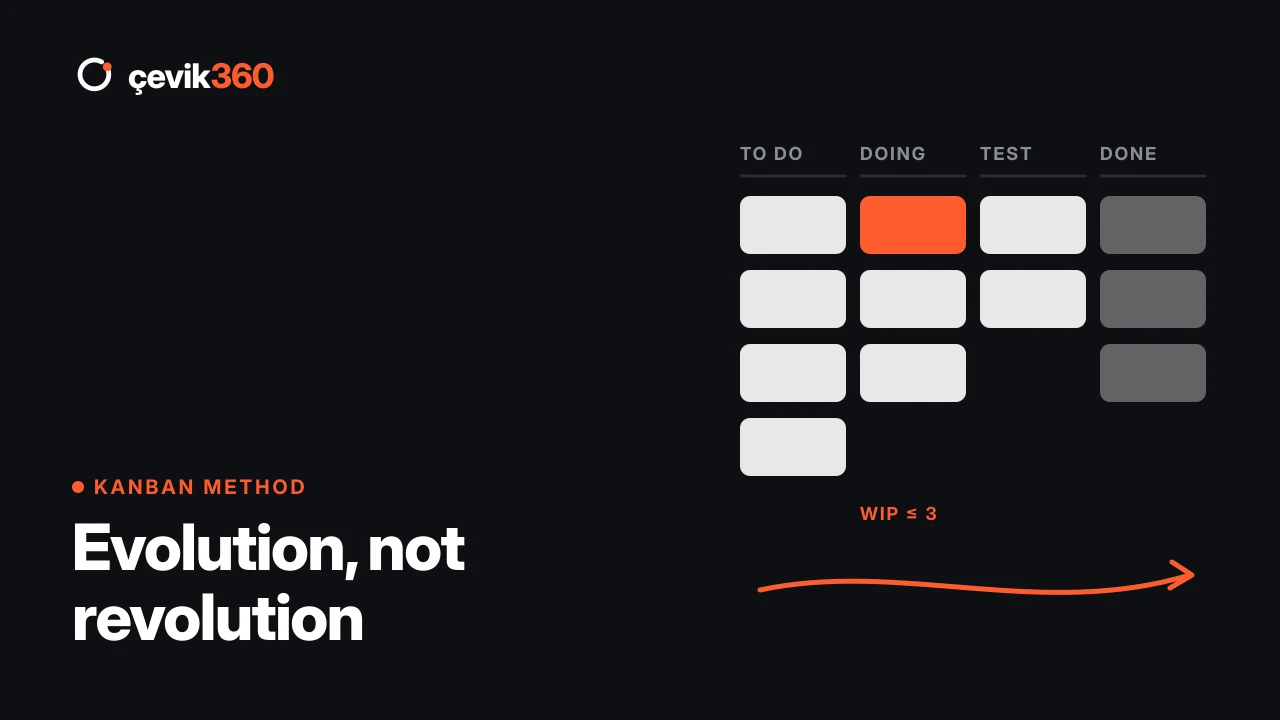
The Kanban Method looks at change from the opposite direction. It doesn’t impose a new structure. It starts with what you do now and improves it in small, measurable steps. That’s why Kanban is often called an evolutionary change method.
For many teams, Kanban is a board with “To do / Doing / Done” columns. The board is the visible form of the work, but the real power of the Kanban Method lies in the principles behind it. Introduced by David J. Anderson and developed by Kanban University, the method rests on two groups of principles and six general practices.
1. Start with what you do now. You begin without touching your current processes, roles or job titles. First you make today’s flow visible, exactly as it is. This lowers natural resistance to change from the start, because nobody is told “what you’re doing is wrong”.
2. Agree to pursue improvement through evolutionary change. Instead of big, risky transformation steps, you run small, reversible experiments. Each experiment is a hypothesis: “If we put a WIP limit on the test column, items will wait less in testing.” The result is judged with data; if it works it stays, if not it’s rolled back.
3. Encourage acts of leadership at all levels. Improvement isn’t only expected from managers. A tester who notices a stuck item on the board and pulls the team together is showing leadership too. Kanban makes these small acts of leadership visible and encourages them.
1. Visualise. Make the work, the workflow and business risks visible. Showing waiting states as separate columns reveals, beyond argument, where the waiting builds up.
2. Limit work in progress. Limiting how many items can be started at once turns Kanban from a push system into a pull system. When space opens in a column, new work is pulled in.
3. Manage flow. Watch how fast and how predictably work flows. This is where cycle time, throughput and work item age come in. See our article on flow metrics for details.
4. Make policies explicit. Rules like “when is an item ready for test?” or “how is urgent work defined, and how does it jump the queue?” should be written down and known by everyone. Explicit policies move the debate from people to rules.
5. Implement feedback loops. The daily Kanban meeting, a regular service delivery review, risk and strategy reviews. The Kanban Method calls these cadences.
6. Improve collaboratively, evolve experimentally. Using models and the scientific method; with data and experiments, not guesses.
Picture a customer service software team. It serves requests from business units that arrive scattered across email, phone and meetings. Nobody knows how much work is waiting.
Week one: without changing any process, we move all current work onto a single board. The columns reflect what the team actually does. The first discovery is often surprising: there are two or three times more items on the board than the team expected.
Month two: waiting columns are added and work item age is tracked. The longest wait becomes visible, for example business approval. This is information for changing a policy, not for blaming a person.
Month three: the first WIP limit experiment. Then the request intake is reduced to a single entry point and a weekly prioritisation cadence is set up. Every step is small and reversible, and the effect of each one is measured with data.
On this journey nobody’s title changed and no big reorganisation took place. Yet the flow of work improved step by step, in full view of the team and its stakeholders.
To be fair, evolutionary change isn’t always enough on its own. If the organisational structure is a fundamental obstacle to flow, for example if finishing anything requires five departments to hand work back and forth, improvements on the board will eventually hit a ceiling. Even then Kanban is valuable: it shows with data why structural change is needed. The decision is made not on gut feeling but on a concrete finding such as “our work spends 70% of its time waiting between departments.”
This question is usually asked the wrong way. The Kanban Method isn’t there to replace one framework with another; it can be used to improve whatever process you have. A team using Scrum can manage the flow inside its sprint with Kanban practices too. What matters is moving forward step by step, with visibility and data, without dropping change on anyone overnight.
If you’d like to bring Kanban into your organisation with an evolutionary approach, have a look at our approach or get in touch.
WIP, cycle time, throughput and work item age: the four flow metrics that show where work waits, what they tell you and how to use them.
AI speeds up coding, but work still waits for decisions, reviews and tests. What to know before you shorten your sprints.
The eight most common mistakes in agile adoption, from ignoring culture to limiting team autonomy, and how to avoid them.
In a 30-minute call, let's find the bottlenecks in your flow together.