Agile Methods and Continuous Improvement: An Organisation That Grows at Every Stage
What is continuous improvement and how do agile and lean put it into practice? Kaizen, PDCA, flow metrics and seven principles of a lasting system.
Articles / Lean & Continuous Improvement
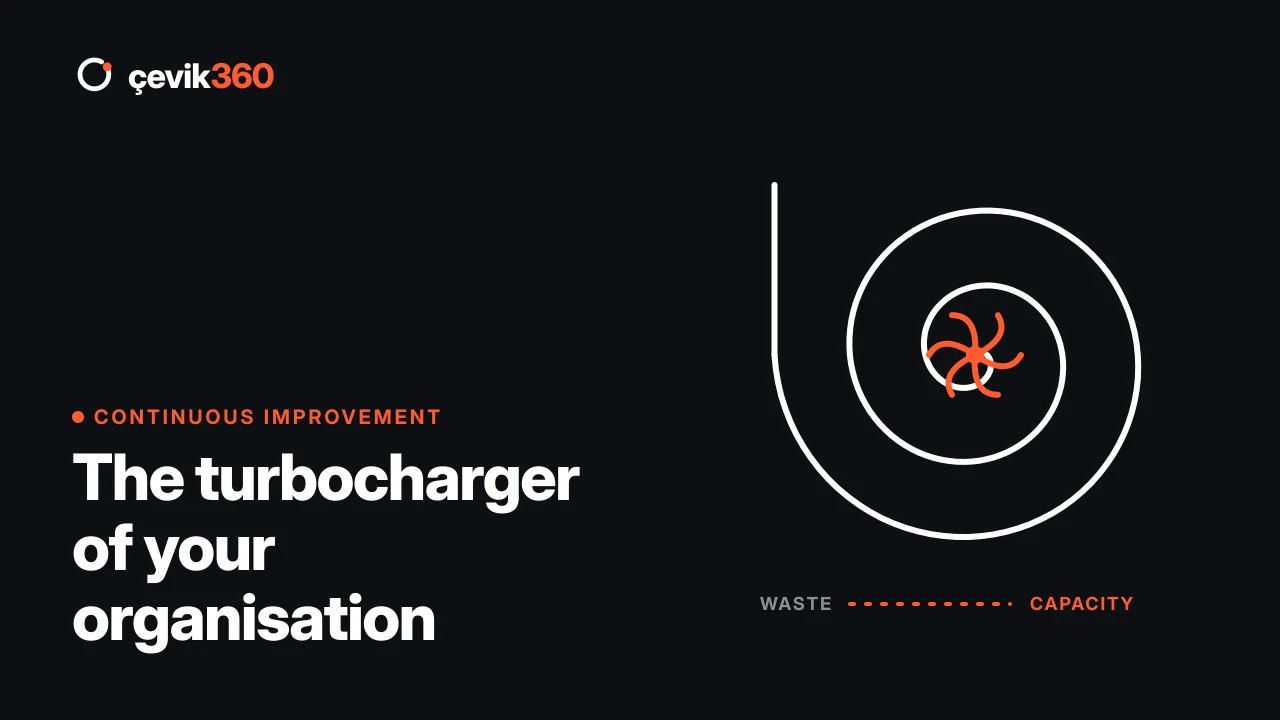
What a turbocharger does in a car engine is clever. While the engine runs, hot gas leaves through the exhaust; normally that energy is simply thrown away. The turbo uses the exhaust gas to spin a turbine, and the turbine compresses the air going into the engine. The result: more power from the same engine size and the same fuel. A turbo isn’t a new engine; it recovers energy the existing engine was wasting.
Continuous improvement does exactly this for organisations.
Every organisation produces “exhaust” while it runs: waiting work, rework, misunderstood requests, unnecessary approval steps, defects to fix, reports nobody reads. In lean thinking these are called waste. Most organisations throw this energy away: the problem gets fixed, work carries on, and the same problem shows up again next month.
An organisation that practises continuous improvement routes that exhaust into the turbine. Every problem is a data point about how the system works. Every recurring defect points to a process step that can be fixed. Problems become fuel.
A turbo doesn’t add a cylinder to the engine. It makes every existing cylinder work better. Continuous improvement is the same:
From the field: what wastes the most time in transformation programmes isn’t learning the new method; it’s living through the same problems again and again. Teams that discuss the same items in every retrospective are the classic example. It’s like an engine with a turbo fitted while the exhaust is still vented outside.
A turbo needs a turbine, a compressor and the connection between them. Continuous improvement has similar parts:
If exhaust never reaches the turbine, nothing happens. If problems stay invisible, nothing improves. Kanban boards, flow metrics, open conversation within the team and a culture of “speak up when you see a problem” come in here. People who raise problems need to be thanked, not blamed.
The heart of Kaizen is small, continuous steps. Every improvement can be set up as a PDCA cycle (Plan, Do, Check, Act):
Improvement doesn’t last unless it becomes the new standard. In a turbo, compressed air enters the engine and adds power; in improvement, the lesson learned enters the process, a checklist, the Definition of Done or an explicit policy.
A turbo works once the engine is above a certain speed. Continuous improvement also needs a regular rhythm: weekly improvement meetings, retrospectives, monthly flow reviews. Improvement without rhythm becomes an occasional clean-up.
The objection we hear most often: “We don’t have time to improve; we can’t keep up with the work.” That’s like an engine that stays without a turbo because it doesn’t want to carry the weight. If work can’t keep up, the cause is usually waste, and waste doesn’t shrink unless time is set aside for it.
Our advice: reserve a small but protected share of team capacity for improvement. It can be one improvement item per sprint, a fixed few hours a week, or a separate swimlane on the Kanban board. What matters is that this capacity isn’t the first thing cut when urgent work arrives.
A turbo’s effect shows on the dashboard. The effect of continuous improvement should be visible too:
We explained how to read these metrics in our article on flow metrics. Showing improvement as a measured result rather than a feeling is the strongest way to keep management support.
Not every turbo makes an engine stronger; a badly tuned one strains it. Continuous improvement has similar traps:
Continuous improvement isn’t a project; it’s a way of working. A turbo is fitted once and works for as long as the engine runs. Set up well, your organisation becomes a system that feeds on its own problems and gets a little stronger every month.
To build a continuous improvement system in your organisation, see our continuous improvement services or start with the free 360 assessment.
What is continuous improvement and how do agile and lean put it into practice? Kaizen, PDCA, flow metrics and seven principles of a lasting system.
In a 30-minute call, let's find the bottlenecks in your flow together.